Thursday, August 5, 2010

Workshop “Mechano-Chemical transformations of wood during Thermo-Hydro-Mechanical processing”

Workshop
“Mechano-Chemical transformations of wood
during Thermo-Hydro-Mechanical processing”

February 16-18, 2011
Biel (Bienne), Switzerland
contact person : Parviz Navi (parviz.navi@bfh.ch)

Workshop objectives
The objectives of this workshop is to present and discuss the state of art of THM and Thermo-Hydrous (TH) processing in open and closed systems and the challenges faced in wood characterization for process scaling-up from laboratory to full industrial production, through the discussion of latest research results and new ideas.
The advantage of combining renewable resources such as “wood” with a processing technique with low environmental impact to achieve a new high quality material is highly desirable. However, there are many problems associated with TH/THM processing, which require an interdisciplinary approach to be resolved. This means that a close collaboration between the wood mechanics and wood chemistry communities from both academia and industry is needed.
The workshop will bring together experts and young scientists from European academia as well as from other countries, and industry. It will encourage dissemination of the latest research works, exchanging and developing new ideas, and building collaborations between laboratories and research activities.

Workshop Topics:
Thermo-Hydrous (Heat treatment) in close systems
Modelling of THM wood treated by closed systems
Innovation and new products by THM-open systems

Call for Papers

Please send the abstracts to parviz.navi@bfh.ch

October 31, 2010 Extended abstract submission deadline.
November 12, 2010 Notification of Acceptance of the Abstract
November 19, 2010 Registration deadline
December 17, 2010 Submission of revised abstract based on the format given in the Action Website (which is under construction).

Saturday, February 13, 2010

Wood Welding


No additives are used to create the connection in wood welding. By the generation of energy by friction, focused on the interface of the pieces to be connected, a transformation of the wood structure by pyrolysis is obtained. The result is a sticking material which ensures the connection in form of an adhesive layer. A circular motion is applied to the parts to be welded. Since the process is controlled by the generation of heat due to the frictional movement, the parameters, which are influencing the generation of heat are of great importance: These are on the one hand, the machine settings such as for example the welding pressure, the frequency and the amplitude of the frictional movement; in addition, the material properties such as moisture content, orientation of the annual rings, density, the species of wood, etc. play an important role. The interfacial temperature defines the physical properties of the interface, which undergoes various «states of aggregation» (solid, liquid, gaseous) during the process of welding. The thermal decomposition of the material leads to the formation of newly formed chemical compounds. Examinations of the microstructure of the interfacial region give an indication how adherence between the welded parts happens.
(summary and the first picture from website of the laboratory for timber construction at EPFL)


Sunday, December 27, 2009

Grow-your-own to replace false teeth

guardian.co.uk

The British institution of dentures sitting in a glass of water beside the bed could be rendered obsolete by scientists who are confident that people will soon be able to replace lost teeth by growing new ones.

Instead of false teeth, a small ball of cells capable of growing into a new tooth will be implanted where the missing one used to be.

The procedure needs only a local anaesthetic and the new tooth should be fully formed within a few months of the cells being implanted.

Paul Sharpe, a specialist in the field of regenerative dentistry at the Dental Institute of King's College, London, says the new procedure has distinct advantages over false teeth that require a metal post to be driven into the jaw before being capped with a porcelain or plastic tooth.

"The surgery today can be extensive and you need to have good solid bone in the jaw and that is a major problem for some people," Professor Sharpe said.

The method could be used on far more patients because the ball of cells that grows into a tooth also produces bone that anchors to the jaw.

The choice of growing a new tooth is likely to appeal to patients. "Anyone who has lost teeth will tell you that, given the chance, they would rather have their own teeth than false ones," said Prof Sharpe. The average Briton over 50 has lost 12 teeth from a set of 32.

The procedure is fairly simple. Doctors take stem cells from the patient. These are unique in their ability to form any of the tissues that make up the body. By carefully nurturing the stem cells in a laboratory, scientists can nudge the cells down a path that will make them grow into a tooth. After a couple of weeks, the ball of cells, known as a bud, is ready to be implanted. Tests reveal what type of tooth - for example, a molar or an incisor - the bud will form.

Using a local anaesthetic, the tooth bud is inserted through a small incision into the gum. Within months, the cells will have matured into a fully-formed tooth, fused to the jawbone. As the tooth grows, it releases chemicals that encourage nerves and blood vessels to link up with it.

Tests have shown the technique to work in mice, where new teeth took weeks to grow. "There's no reason why it shouldn't work in humans, the principles are the same," said Prof Sharpe.

His team has set up a company, Odontis, to exploit the technique, and has won £400,000 from the National Endowment for Science, Technology and the Arts and the Wellcome Trust.

Sunday, December 6, 2009

Workshop Announcement: Strategic Workshop on Principles and Development of Bio-Inspired Materials

Strategic Workshop on Principles and Development of Bio-Inspired Materials

BOKU - University of Natural Resources and Applied Life Sciences, Vienna
COST - European Cooperation in Science and Technology

Date

Tuesday 13th April 2010 - Thursday 15th April 2010, Vienna, Austria

Venue

University of Natural Resources and Applied Life Sciences, Vienna
Peter Jordan Str. 82
A-1190 Vienna, Austria

Local Organizer

University of Natural Resources and Applied Life Sciences, Vienna
Department of Material Sciences and Process Engineering
Institute of Physics and Materials Science (IPM)
Univ.-Prof. Stefanie Tschegg
Peter-Jordan-Straße 82
1190 Wien Tel: +43 1 47654 5160
Fax: +43 1 47654 5159
email: biomat(at)boku.ac.at


Aims

Bio-inspired materials are becoming of increasing interest in many fields of practical applications. In contrast to man-made materials natural materials such as wood, bone and shells are composed of only limited number of basic components. They gain their diversity in mechanical properties by hierarchical structuring which allows them to fulfil a variety of functions e.g. self-healing, mechanical stability, high toughness.

Due to the quickly advancing physical characterisation techniques our knowledge of the hierarchical structures has increased significantly in recent years and the secrets of form-function relationships are slowly unveiled. But combining the knowledge of natural materials with modern techniques of simulation and fabrication is still the exception due to the lack of communication between bio- and material scientists.

This workshop funded by the COST office aims to be the direct interface between the biological and the processing side to unfold the full potential of bio-inspired materials

The aim of the COST Strategic Workshop is to provide a forum to stimulate interactions between relevant disciplines including biology, materials science, biomimetics, engineering and physics.

The workshop will be organised along three main themes:

  • Material Design Strategies of Nature
  • Implementation of Biological Concepts (Abstraction and Translation)
  • Applications

Tuesday, September 1, 2009

Introducing open access journal of Wood Engineering

The Journal of Wood Engineering(JWE) is a multidisciplinary peer-reviewed journal published monthly by Academic Journals (www.academicjournals.org/JWE). JWE is dedicated to increasing the depth of research across all areas of this subject.

Thursday, August 13, 2009

Artificial Bone Made of Wood

A new procedure to turn blocks of wood into artificial bones has been developed by Italian scientists (in Instituto Di Scienza E Techologia Dei Materiali Ceramici), who plan to implant them into large animals, and eventually humans.

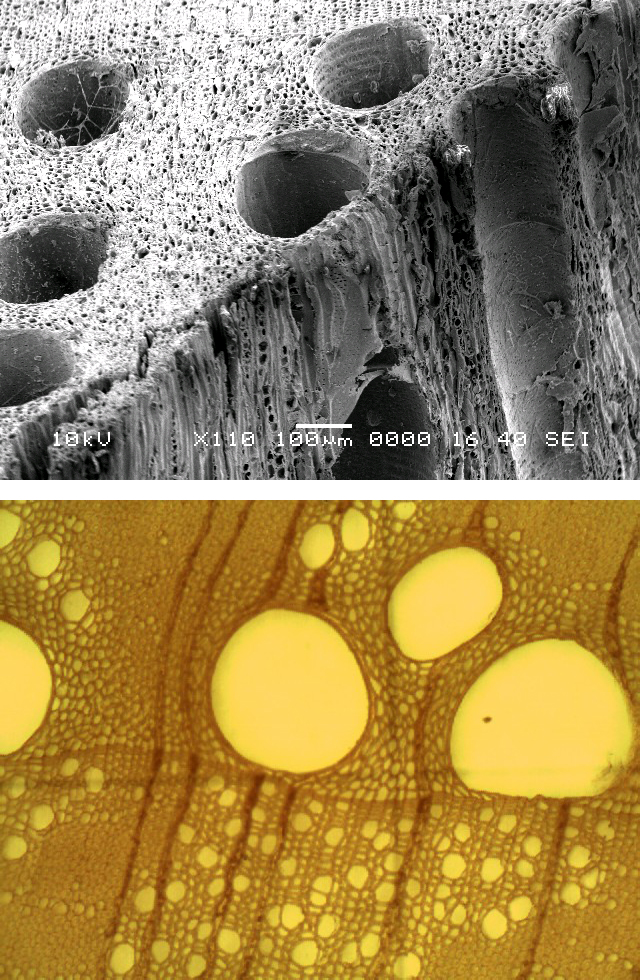
They say the wood-derived bone substitute should allow live bones to heal faster and more securely after a break than currently available implants.Wood closely resembles the physical structure of natural bone, which is very difficult to reproduce with conventional processing technology.

To create the bone substitute, a block of wood, red oak, is heated until all that remains is pure carbon, which is basically charcoal. Then, they should spray calcium over the carbon, creating calcium carbide. Additional chemical and physical steps convert the calcium carbide into carbonated hydroxyapatite, which can then be implanted and serves as the artificial bone.

hardwood microstructure

cancellous bone microstructure

Wednesday, August 5, 2009

Gecko setae


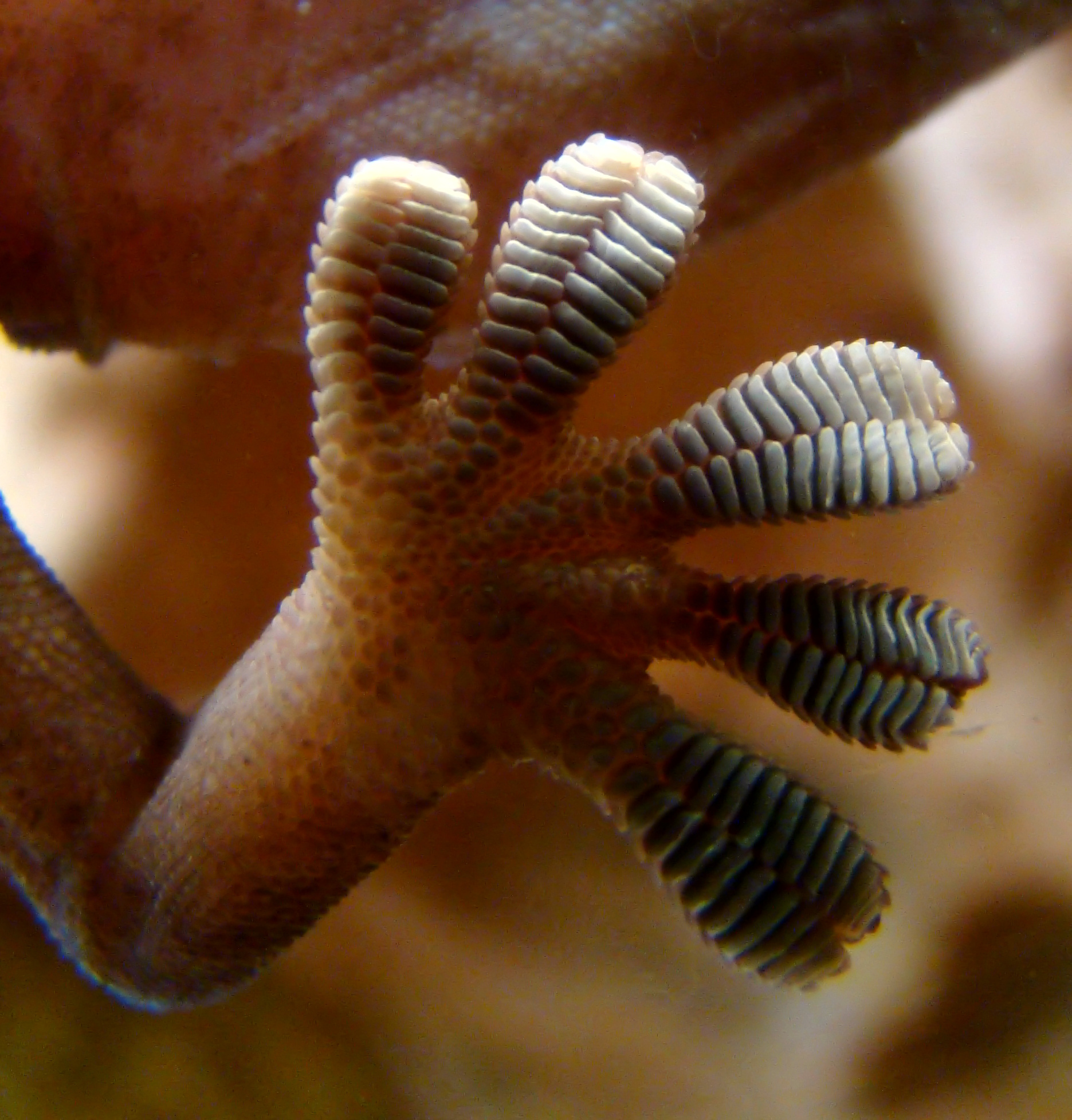
Gecko setae stick more strongly the faster they slide. This is because friction between dry, hard, macroscopic materials typically decreases at the onset of sliding, and as velocity increases, friction continues to decrease because of a reduction in the number of interfacial contacts, due in part to wear. Gecko setae did not exhibit the decrease in adhesion or friction characteristic of a transition from static to kinetic contact mechanics. Instead, friction and adhesion forces increased at the onset of sliding and continued to increase with shear speed from 500 nm/s to 158 mm/s.

see more here
(Rate-dependent frictional adhesion in natural and synthetic gecko setae, by Gravish et al)